
 Kia Sportage: Manual transmission: (if equipped)
|
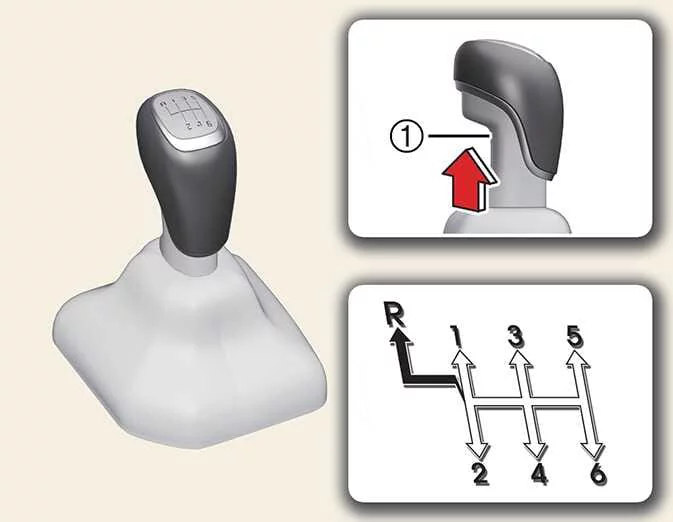
 The shift lever can be moved
without pressing button (1).
 Press button (1) when moving the shift lever into R
(Reverse).
Operation
-
Press the clutch pedal fully while changing gear, then release it gradually.
Using the clutch
Before changing gear, press the clutch pedal all the way down, then release it slowly and smoothly. While driving, keep your foot off the clutch pedal once it is fully released; resting your foot on it can cause unnecessary clutch wear.
Do not use partial clutch engagement to hold the Kia Sportage on an incline, as this also causes unnecessary wear. Use the foot brake or parking brake to keep the vehicle stationary, and avoid pressing and releasing the clutch rapidly or repeatedly.
Downshifting
In heavy traffic or when climbing a steep hill, shift to a lower gear before the engine begins to labour. Downshifting can help prevent the engine from stalling and provide better acceleration when you need to increase speed again.
When descending a steep hill, selecting a lower gear can help control the vehicle’s speed and reduce reliance on the brakes, helping to extend brake life.
TIP
-
If the vehicle has an ignition lock switch, the engine will not start unless the clutch pedal is depressed.
-
Return the shift lever to N (Neutral) before selecting R (Reverse). Press the button below the shift knob, move the lever sufficiently to the left, and then shift into R (Reverse).
-
Bring the Kia Sportage to a complete stop before shifting into R (Reverse).
-
Do not allow the engine speed shown on the tachometer to enter the red zone.
-
In cold weather, shifting may feel difficult until the transmission lubricant has warmed. This is normal and does not damage the transmission.
-
If the vehicle is fully stopped and it is difficult to shift into 1st gear or R (Reverse), leave the lever in N (Neutral) and release the clutch pedal. Press the clutch pedal down again, then select 1st gear or R (Reverse).
WARNING
-
Before leaving the driver’s seat, apply the parking brake fully and switch off the engine. Then select 1st gear when parking on level ground or facing uphill, or R (Reverse) when parking facing downhill. Follow these steps in order to reduce the risk of unexpected vehicle movement.
-
Do not use engine braking by rapidly shifting from a high gear to a lower gear on a slippery road. The vehicle could skid and cause an accident.
-
Press the clutch pedal fully and allow it to return to its normal position before pressing it again. Repeatedly pressing the pedal before it has returned fully may damage the clutch system.
-
Do not overload the vehicle. Starting or driving under excessive load can create too much frictional heat in the clutch disc and may damage the disc and clutch cover.
-
When moving off or reversing, release the clutch pedal gradually after selecting a gear. Releasing it too quickly may cause the engine to stall and could lead to an accident.
CAUTION
-
When shifting down from 5th gear to 4th, take care not to push the lever sideways and accidentally select 2nd gear. A sudden downshift can raise engine speed into the tachometer’s red zone and damage the engine or transmission.
-
Do not downshift by more than two gears at a time. When selecting a lower gear, operate the clutch carefully and make sure engine speed will remain below the red zone. An excessive downshift can damage the engine, clutch and transmission.
-
To prevent premature clutch wear or damage, do not rest your foot on the clutch pedal while driving. Do not use the clutch to hold the vehicle on an uphill slope, such as while waiting at a traffic light.
-
Do not rest your hand on the shift lever while driving. This may cause premature wear to the transmission shift forks.
-
To help prevent clutch system damage, do not start in 2nd gear unless starting on a slippery road.
-
Press the clutch pedal fully whenever you operate it. If it is not fully depressed, the clutch may be damaged or make noise.
 Transmission
 Automatic transmission: (if equipped)
See also:
Climate control air filter
Filter inspection
The climate control air filter should be replaced according to the maintenance
schedule. If the vehicle is operated in severely air-polluted cities or on dusty
rough roads for a ...
Parking on hills
Generally, if you have a trailer attached to your vehicle, you should not park
your vehicle on a hill. People can be seriously or fatally injured, and both your
vehicle and the trailer can be dama ...
Crankshaft Position Sensor (CKPS): Troubleshooting
Wave Form
...
Categories
- Home
- Kia Sportage NQ5 (2022-2026) Owner's Manual
- Kia Sportage QL (2015-2019) Owner's Manual
- Kia Sportage QL (2015-2019) Service Manual
- Kia Sportage SL 2010-2016 Owner's Manual
- Kia Sportage SL 2010-2016 Service Manual
