
 Kia Sportage: Child restraint system (CRS)
Our recommendation: Children should always be in the rear
Infants and young children must travel in a suitable rear-facing or forward-facing child restraint system (CRS), correctly secured to a vehicle seat. Follow the CRS manufacturer's instructions for installation and use.
Children under 13 should always ride in a rear seat and be properly restrained. This helps reduce the risk of injury during a collision, sudden stop or abrupt manoeuvre.
Accident statistics show that children are safer when correctly restrained in a rear seat than in the front. Children who have outgrown a CRS must use the seat belts provided in the vehicle.
Many countries require children to travel in an approved child restraint system.
Rules specifying when a child may use a seat belt instead of a CRS vary by country and may be based on age, height or weight. Check the requirements that apply where you live and wherever you travel.
Install each CRS correctly in a suitable vehicle seat. Always use a commercially available restraint system that meets the applicable requirements in your country.
WARNING
-
Always restrain children correctly in the vehicle. Children of every age are safer in the rear seats. Never install a rear-facing CRS on the front passenger seat unless the air bag has been deactivated.
-
Follow the CRS manufacturer's instructions for installation and use every time.
-
Make sure your child is properly secured in the CRS before every journey.
-
Do not use an infant carrier or child seat that hooks over a seatback. It may not provide adequate protection in a collision.
-
After an accident, have the child restraint system inspected by a professional workshop. Kia recommends visiting an authorised Kia dealer/service partner.
Selecting a Child Restraint System (CRS). Child restraint system types
Operation
-
Choose a CRS that suits your child's height and weight. Check the product label or the manufacturer's instructions for this information.
-
Confirm that the CRS fits the seating position in the Kia Sportage where you plan to install it.
TIP
-
Check that the CRS carries a label confirming compliance with the safety standards applicable in your country.
A CRS may be installed only if it has been approved under ECE-R44, ECE-R129 or other relevant regulations.
-
Select the CRS according to your child's height and weight, as stated on the required label or in the manufacturer's instructions.
-
Make sure the CRS is suitable for the vehicle seating position where it will be used.
For guidance on which seating positions are suitable for belted and ISOFIX child restraint systems, refer to “Suitability of each seating position for belted & ISOFIX Child Restraint Systems (CRS) according to UN regulations (Information for use by vehicle users and CRS manufacturers).”
-
Read and follow all warnings and instructions supplied with the CRS for its installation and use.
Child restraint system types
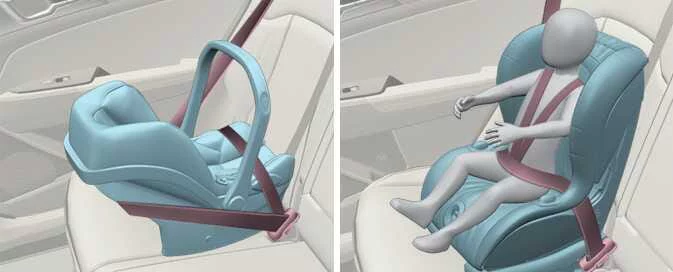
Forward-facing and rearward-facing child restraint systems
|
A rearward-facing child restraint system (CRS) supports the child with the seat surface against their back and secures them with a harness. In a collision, this design helps keep the child positioned in the restraint and reduces stress on the neck and spine, which are especially vulnerable in young children.
Children under one year old must always travel in a rearward-facing CRS. Infant-only restraints are designed for rearward-facing use. Convertible and 3-in-1 restraints can also be used rearward-facing and typically allow higher height and weight limits, so a child may remain in this position for longer.
Continue using the CRS rearward-facing until your child reaches the height or weight limit specified by its manufacturer.
A forward-facing CRS uses a harness to restrain the child's body. Keep your child in a forward-facing restraint with its harness until they reach the maximum height or weight limit set by the manufacturer.
Once your child outgrows the forward-facing CRS, they are ready to use a booster seat.
Booster seats
A booster seat is a type of CRS that helps position the vehicle's seat belt correctly over the stronger parts of a child's body. Use a booster until your child is large enough for the seat belt to fit properly without it.
When the belt fits correctly, the lap section lies comfortably across the upper thighs rather than the stomach. The shoulder section should cross the shoulder and chest without touching the neck or face. Children under 13 must always be properly restrained to reduce the risk of injury in a collision, sudden stop or abrupt manoeuvre.
Installing a Child Restraint System (CRS)
Operation
-
Install and secure the CRS correctly in the vehicle.
-
Check that the restraint is firmly fixed in place.
-
Secure your child in the CRS according to the manufacturer's instructions.
WARNING
-
Before installing a CRS in your Kia Sportage, read and follow all instructions supplied by its manufacturer. Failure to follow the warnings and directions may increase the risk of serious injury or death in a collision.
-
If a vehicle headrest prevents the CRS from being installed correctly, adjust the headrest or remove it for that seating position, as appropriate.
CAUTION
A CRS left inside a closed vehicle can become very hot. Before placing your child in it, check the seat surface and buckles to help prevent burns.
 Care of seat belts
 ISOFIX anchorage and top-tether anchorage (ISOFIX anchorage system) for children
See also:
Hazard Lamp Switch: Repair procedures
Removal
1.
Disconnect the negative (-) battery terminal.
2.
Remove the center fascia panel (A).
(Refer to BE group - "Audio unit")
Take care not to damage and sc ...
Relay Box (Passenger Compartment): Description and Operation
Description
SJB (Smart Junction Box)
1.
Specification
ItemRequirementRemarkRated voltageDC 12V?Voltage rangeDC 9 ~ 16VNormal operating in this rangeStorage temperature-40°C ~ +80°C?Operating ...
Air cleaner filter. Replacing the air cleaner filter. Climate control air filter. Replacing the climate control air filter
Air cleaner filter. Replacing the air cleaner filter
Replacing the air cleaner filter
Procedure
Lift lever (1) on the air cleaner cover to release the lock.
...
Categories
- Home
- Kia Sportage NQ5 (2022-2026) Owner's Manual
- Kia Sportage QL (2015-2019) Owner's Manual
- Kia Sportage QL (2015-2019) Service Manual
- Kia Sportage SL 2010-2016 Owner's Manual
- Kia Sportage SL 2010-2016 Service Manual
