
 Kia Sportage: Climate control system. Operating climate control system
Climate control system components
The Kia Sportage climate control air filter traps dust and other airborne pollutants before outside air enters the cabin. As the filter collects contaminants, airflow from the vents may gradually weaken. Moisture can then build up on the inside of the windscreen, even when fresh-air intake is selected.
Replace the climate control air filter when needed. If you are unsure how to do this, have the work carried out by a professional workshop; Kia recommends an authorised Kia dealer or service partner. For replacement instructions, refer to the Air cleaner filter section.
CAUTION
Replace the climate control air filter at the intervals specified in the Maintenance Schedule. Delaying replacement can reduce airflow and heating or cooling performance, and may cause unpleasant odours inside the vehicle.
NOTE
If airflow from the vents drops suddenly, have the climate control system inspected by a professional workshop. Kia recommends an authorised Kia dealer or service partner.
Air conditioning refrigerant label
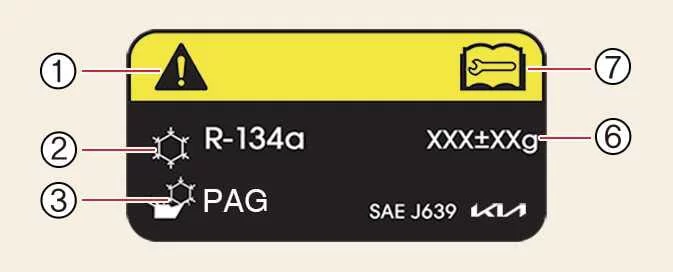 |
|
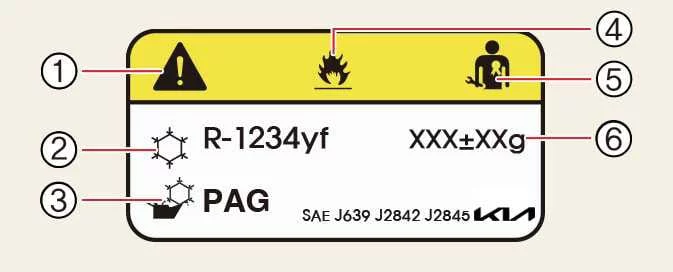 |
|
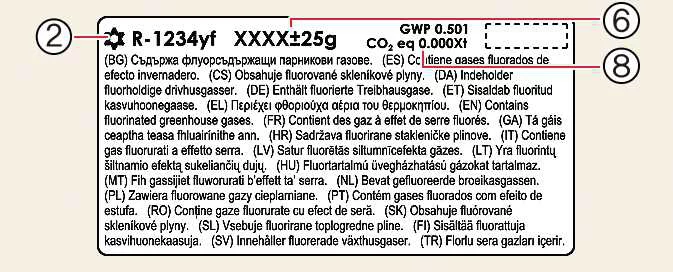 |
-
Caution
-
Refrigerant classification
-
Compressor lubricant classification
-
Flammable refrigerant
-
Requirement for a registered air conditioning service technician
-
Refrigerant charge amount
-
Service manual reference
-
CO2 equivalent of the refrigerant
The refrigerant label inside the engine compartment identifies the type of air conditioning refrigerant used in your Kia Sportage. Refer to the Refrigerant label section for further information.
TIP
If the refrigerant charge is too low, air conditioning performance will decline. An excessive charge can also impair system operation.
If the air conditioning system behaves abnormally, have it inspected by a professional workshop. Kia recommends an authorised Kia dealer or service partner.
WARNING
-
Vehicles equipped with R-134a
 The air conditioning
system operates under high pressure and must be serviced only by trained, certified technicians. The correct
refrigerant type and quantity of oil and refrigerant must be used.
Incorrect service or materials can damage the vehicle and cause personal injury.
-
Vehicles equipped with R-1234yf


R-1234yf is mildly flammable and the air conditioning system operates under high pressure. Have the system serviced only by trained, certified technicians.
Use only the specified type and quantity of oil and refrigerant. Refrigerant must be recovered with suitable equipment; releasing it directly into the atmosphere can harm people and the environment. Ignoring these precautions may result in serious injury.
CAUTION
Air conditioning repairs
The wrong type or amount of oil or refrigerant can damage the vehicle. To protect the air conditioning system, have it serviced only by trained, certified Kia technicians.
Operating climate control system
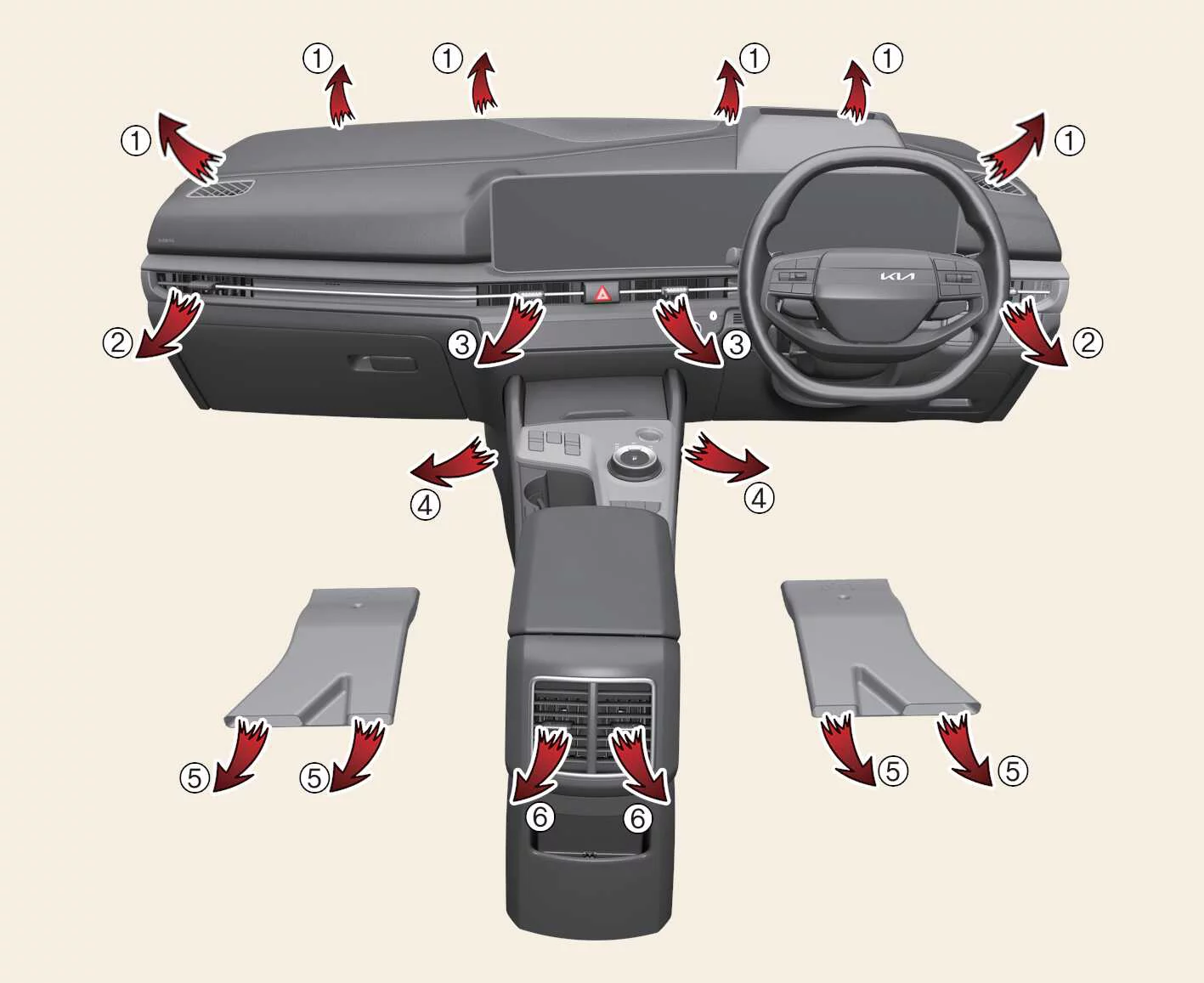
|
Mode |
Airflow direction |
Air outlets |
|---|---|---|
|
|
Air is directed towards the upper body and face. |
2, 3, 6 |
|
|
Air is directed towards the face and floor. |
2, 3, 4, 5, 6 |
|
|
Most of the airflow goes to the floor. A smaller amount is directed to the windscreen, side window defrosters and side air vents. |
1, 2, 4, 5, 6 |
|
|
Most of the airflow is directed to the floor and windscreen, with a smaller amount sent to the side window defrosters and side air vents. |
1, 2, 4, 5, 6 |
|
|
Most of the airflow is directed to the windscreen, with a smaller amount sent to the side window defrosters and side air vents. |
1, 2 |





Operation
-
Start the vehicle before operating the climate control system.
-
Select the airflow mode you want. For more effective heating or cooling, use the corresponding mode:
-
Heating:

-
Cooling:

-
-
Set the temperature control to the level you prefer.
-
If needed, select outside (fresh) air using the air intake control.
-
Choose the fan speed that provides the airflow you want.
-
If desired, switch the air conditioning on while setting a high temperature to dehumidify the air entering the cabin.
If the windscreen begins to fog, select Front Defrost mode:

Selecting air flow modes
 |
|
 |
|
 |
Operation
-
Choose where air should enter the cabin through the ventilation outlets.
On automatic Type A systems, the airflow outlets change in the sequence shown below.
 |
Controlling air intake
 |
 |
Operation
-
Select either outside (fresh) air or recirculated air, depending on the conditions and the setting you need.
-
Outside (fresh) air: Air is drawn into the vehicle from outside. On versions without a dedicated outside-air button, the indicator light is off when this mode is selected.
-
Recirculated air: Air from the passenger compartment is circulated through the heating system. On versions without a dedicated outside-air button, the indicator light illuminates when this mode is selected.
WARNING
-
Using recirculated air continuously can raise humidity inside the Kia Sportage. The windows may fog, reducing visibility.
-
Never sleep in a vehicle with the heating or air conditioning system operating. A drop in oxygen levels or body temperature could cause serious injury or death.
-
Prolonged use of recirculated air while driving can cause drowsiness and reduce your ability to control the vehicle. Use outside (fresh) air as much as possible while driving.
NOTE
Running the heater for an extended time with recirculated air selected and the air conditioning off may fog the windscreen and side windows and make the cabin air feel stale. Using the air conditioning for a long time with recirculated air selected can make the cabin air excessively dry.
Controlling instrument panel vents
 |
Operation
-
Adjust each vent to direct airflow where it is needed.
-
To close a vent, move its lever away from the passenger.
-
To open a vent, move its lever towards the passenger.
Air conditioning (A/C)
 |
Operation
-
Press the A/C button to switch the air conditioning on or off.
 Interior lights
 Manual climate control system: (if equipped)
See also:
Front Disc Brake: Repair procedures
Removal
1.
Remove the front wheel & tire.
Tightening torque:
88.3 ~107.9 N.m (9.0 ~11.0 kgf.m, 65.1 ~79.6 lb-ft)
2.
Loosen the hose eyebolt (B) and caliper mounting bolts (C), then ...
Instrument Cluster: Repair procedures
Removal
1.
Disconnect the negative (-) battery terminal.
2.
Remove the cluster fascia panel (A).
3.
Remove the cluster assembly (A) after loosening 4 screws.
4.
Disconnect the cluster ...
Limitations of Forward Collision-Avoidance Assist
Forward Collision-Avoidance Assist may not work as intended, or may respond unexpectedly, in the following
situations. Keep in mind that its operation depends on the detecting sensors, visibility a ...
Categories
- Home
- Kia Sportage NQ5 (2022-2026) Owner's Manual
- Kia Sportage QL (2015-2019) Owner's Manual
- Kia Sportage QL (2015-2019) Service Manual
- Kia Sportage SL 2010-2016 Owner's Manual
- Kia Sportage SL 2010-2016 Service Manual
