
 Kia Sportage: SRS components and functions. Driver's and passenger's front air bags
SRS components and functions
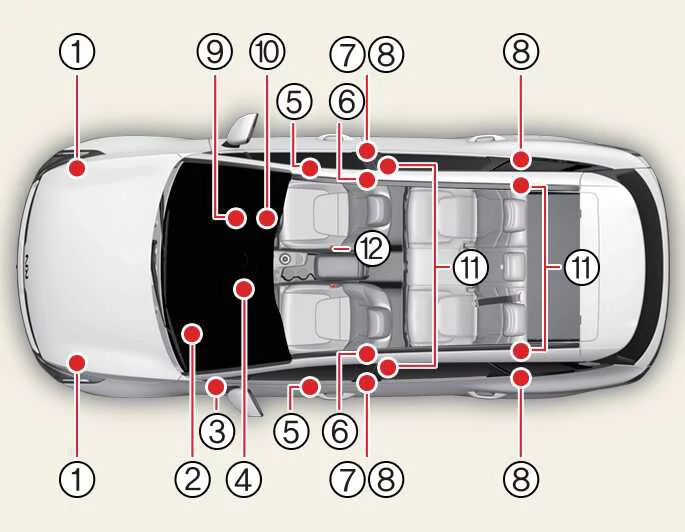
|
|
Equipment shown may vary by Kia Sportage trim, selected options and region. Features marked “if equipped” are available only on vehicles fitted with them.
Operating conditions
-
When the vehicle is switched to ON, the SRS air bag warning light illuminates for approximately 6 seconds, then turns off.
WARNING
Any of the following warning-light behaviours may indicate an SRS malfunction. Have the system inspected by a professional workshop. Kia recommends contacting an authorised Kia dealer/service partner.
-
The warning light does not illuminate briefly when the vehicle is switched to ON.
-
The warning light remains illuminated after the initial approximately 6-second period.
-
The warning light comes on while the vehicle is moving.
-
The warning light flashes while the vehicle is in ON.
Driver's and passenger's front air bags
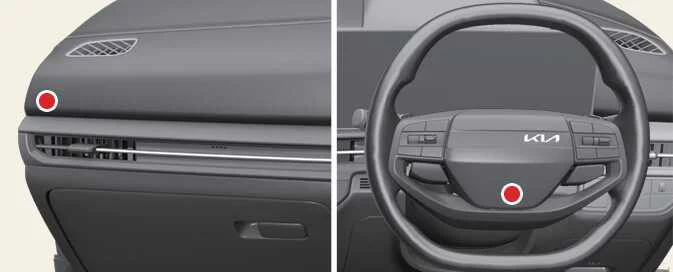
|
The words “AIR BAG” are moulded into the steering wheel air bag cover and into the front passenger's panel above the glove box to identify the air bag locations.
The driver air bag module is in the centre of the steering wheel. The front passenger air bag module is in the panel above the glove box. If the SRS control module (SRSCM) detects a sufficiently severe frontal impact, it automatically commands the front air bags to deploy.
As an air bag inflates, pressure causes tear seams moulded into its cover to separate. The cover then opens far enough to allow the air bag to inflate fully.
A fully inflated air bag works with a correctly worn seat belt to slow the forward movement of the driver or front passenger, helping reduce the risk of head and chest injuries.
After inflating, the air bag begins to deflate immediately. This helps the driver retain forward visibility and continue steering or operating the vehicle's controls.
NOTE
See the warnings, cautions and notes in “Air bag Precautions.”
 Out of position warning
 Side air bag and front centre side air bag: (if equipped). Curtain air bag
See also:
Fuel Tank Pressure Sensor (FTPS): Description and Operation
Description
Fuel Tank Pressure Sensor (FTPS) is a component of the
evaporative emission control system. It is installed on the fuel tank
near the fuel pump assembly. It checks the evaporative s ...
Tachometer
The tachometer indicates the approximate number of engine revolutions per minute
(rpm).
Use the tachometer to select the correct shift points and to prevent lugging
and/or over-revving the engi ...
Front Lower Arm: Repair procedures
Replacement
1.
Remove the front wheel & tire.
Tightening torque :
88.3 ~ 07.9N.m (9.0 ~ 11.0kgf.m, 65.1 ~ 79.6lb-ft)
Be careful not to damage to the hub bo ...
Categories
- Home
- Kia Sportage NQ5 (2022-2026) Owner's Manual
- Kia Sportage QL (2015-2019) Owner's Manual
- Kia Sportage QL (2015-2019) Service Manual
- Kia Sportage SL 2010-2016 Owner's Manual
- Kia Sportage SL 2010-2016 Service Manual
