
 Kia Sportage: Trailer towing: (if equipped)
If you plan to tow with your Kia Sportage, first contact your country’s Department of Motor Vehicles to confirm the legal requirements that apply.
Towing regulations vary by location, and the requirements for trailers, vehicles and other equipment may differ. Kia recommends consulting an authorised Kia dealer or service partner before towing.
Your Kia Sportage can tow a trailer when properly equipped. To find the towing capacity for your specific vehicle, refer to “Weight of the trailer” later in this section.
Towing changes how your vehicle handles and affects its durability and fuel economy. Safe, successful towing depends on using suitable equipment and fitting and operating it correctly.
This section covers established towing guidance and safety requirements. Read it carefully before attaching a trailer so you understand the precautions that help protect you, your passengers and other road users.
The extra trailer weight makes the engine, transmission, wheels and tyres work harder. The engine may need to run at higher speeds and under greater load, producing additional heat. A trailer also increases wind resistance, which adds to the effort required to pull it.
WARNING
-
Incorrect equipment or unsafe driving can cause you to lose control while towing. If a trailer is too heavy, for example, the vehicle’s brakes may not work effectively or may fail to stop the combination. This could result in serious injury or death. Tow only after following all the instructions in this section.
-
Before towing, confirm that the trailer weight, gross combination weight, gross vehicle weight, gross axle weight and trailer tongue load are all within their specified limits.
CAUTION
Improper towing can damage your Kia Sportage and lead to costly repairs that may not be covered by the vehicle warranty. Follow the guidance in this section to tow correctly and reduce the risk of damage.
NOTE
-
Trailer hitch mounting location
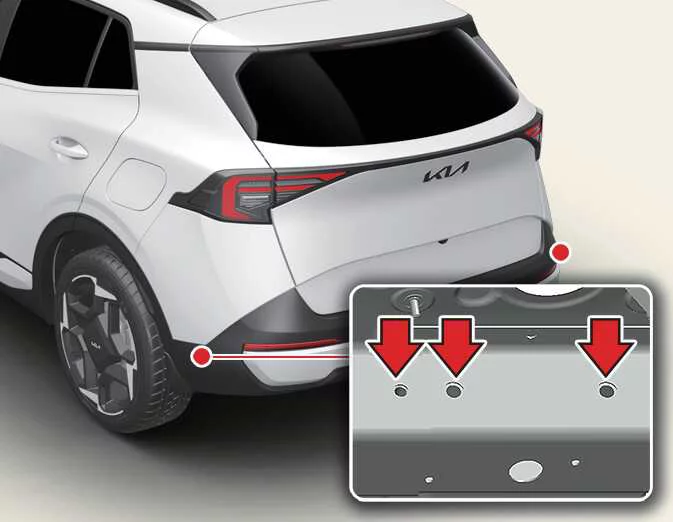
The hitch mounting holes are located on both sides of the underbody, behind the rear tyres.
-
For Europe
-
The technically permissible maximum rear axle load may be exceeded by no more than 15%. The vehicle’s technically permissible maximum laden mass may be exceeded by no more than 10% or 100 kg (220.4 lbs), whichever is lower. If either limit is exceeded, do not drive faster than 100 km/h (62.1 mph).
-
The additional load at the trailer coupling may cause the rear tyres’ maximum load ratings to be exceeded, but by no more than 15%. In this case, do not exceed 100 km/h (62.1 mph), and set the rear tyre pressure at least 20 kPa (0.2 bar) above the pressure recommended for normal use without a trailer.
-
- Hitches. Safety chains
- Trailer brakes
- Driving with a trailer
- Maintenance when trailer towing. If you do decide to pull a trailer
 Winter driving
 Hitches. Safety chains
See also:
Description and Operation
OBD-II review
1. Overview
The California Air Resources Board (CARB) began regulation of
On Board Diagnostics (OBD) for vehicles sold in California beginning
with the 1988 model year. The first ...
ETC (Electronic Throttle Control) System: Specifications
Specification
[Throttle Position Sensor (TPS)]
Throttle Angle(°)Output Voltage(V) [Vref = 5.0V]TPS1TPS200.05.0100.484.52200.954.05301.433.57401.903.10502.382.62602.862.14703.331.67803.811.19904 ...
Wheel replacement
When replacing the metal wheels for any reason, make sure the new wheels are
equivalent to the original factory units in diameter, rim width and offset.
A wheel that is not the correct size may adv ...
Categories
- Home
- Kia Sportage NQ5 (2022-2026) Owner's Manual
- Kia Sportage QL (2015-2019) Owner's Manual
- Kia Sportage QL (2015-2019) Service Manual
- Kia Sportage SL 2010-2016 Owner's Manual
- Kia Sportage SL 2010-2016 Service Manual
