
 Kia Sportage: Winter driving
Severe winter weather can place extra demands on your Kia Sportage and increase wear on some components. A few precautions can help you drive more safely and reduce the risk of weather-related problems.
Use the following guidance when preparing for winter travel and driving in cold conditions:
Snowy or icy conditions
For travel through deep snow, you may need winter tyres or tyre chains. Choose your equipment carefully and drive at a speed suited to the road surface.
If you fit winter tyres, select tyres that match the size and type of the original equipment. Using a different size or type can affect the safety and handling of your Kia Sportage. Avoid speeding, rapid acceleration, sudden braking and sharp turns, as these actions can quickly reduce tyre grip on snow or ice.
When slowing down, make full use of the vehicle’s braking capability, but apply the brakes gently. Sudden braking on a slippery road can cause the vehicle to skid. Leave plenty of space between your vehicle and the one ahead. Tyre chains can improve forward traction, but they do not prevent the vehicle from sliding sideways.
NOTE
Tyre chains are not permitted in every country or region. Check local regulations before fitting them.
Winter tyres
If you install winter tyres, use radial tyres of the same size and load range as the original tyres. Fit them to all four wheels so your Kia Sportage maintains balanced handling in changing winter conditions. Remember that winter tyres may provide less grip on dry roads than the vehicle’s original tyres, so continue to drive with care even when the road appears clear. Ask your tyre dealer about the maximum speed recommended for your tyres.
Before using studded tyres, check local, state and municipal regulations for any restrictions.
WARNING
Winter tyres must match the size and type of the vehicle’s standard tyres. Using tyres that do not meet these requirements may compromise vehicle safety and handling.
Tyre chains
|
Wire-type chain 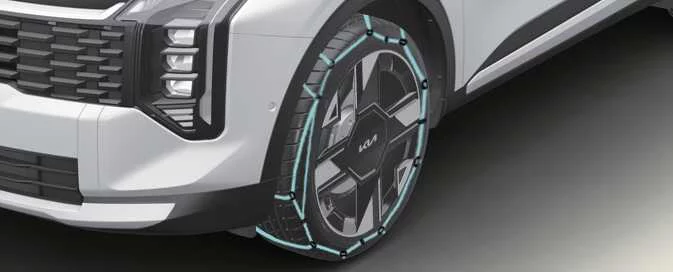
|
Fabric-type chain 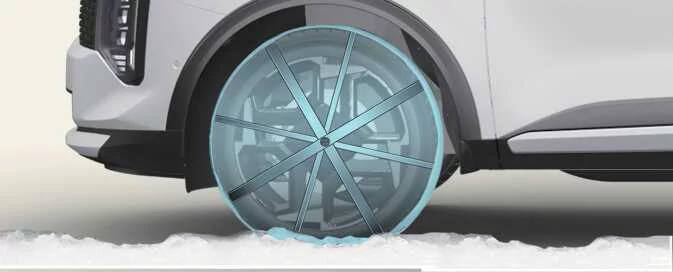
|
Radial tyres have relatively thin sidewalls, which some types of snow chains can damage. Winter tyres are therefore recommended in place of chains where suitable. Do not fit chains to aluminium wheels, as they may damage the wheels. If chains are necessary, use fabric-type chains or wire-type chains less than 12 mm (0.47 inch) thick.
Damage caused by using snow chains incorrectly is not covered by the vehicle manufacturer’s warranty.
Fit chains to the drive wheels as described below:
-
On a front-wheel-drive vehicle, the front wheels provide the driving force, so fit chains to the front tyres.
-
On an all-wheel-drive Kia Sportage, fit chains to the front tyres only. Keep chain use and travel distance to a minimum to reduce the risk of damage to the AWD system.
-
After fitting chains, drive slowly. If they make contact with the vehicle body and create noise, reduce your speed until the noise stops. Remove the chains once you reach a cleared road to prevent damage.
-
Chains of the wrong size or fitted incorrectly can damage brake lines, suspension components, the body or wheels. Follow the chain manufacturer’s fitting instructions and secure the chains as tightly as possible. With chains fitted, drive below 30 km/h (20 mph).
CAUTION
-
Choose chains that are the correct size and type for your tyres. Incorrect chains can damage the body or suspension, and this damage may not be covered by the vehicle manufacturer’s warranty. Chain hooks can also catch on vehicle components, causing the chains to loosen. Use chains certified to SAE Class “S”.
-
After driving approximately 0.5 to 1 km (0.3 to 0.6 miles), stop and check that the chains remain securely fitted. Retighten or refit them if they have loosened.
-
For vehicles fitted with 18-inch (235/55R18) or 19-inch (235/50R19) tyres, use fabric-type chains.
Use high-quality ethylene glycol coolant
Your Kia Sportage is supplied with high-quality ethylene glycol coolant in its cooling system. Use this type of coolant to help protect the system against corrosion, lubricate the water pump and prevent freezing. Replace or top up the coolant according to the maintenance schedule in Section 8.
Before winter begins, have the coolant tested to confirm that its freeze protection is suitable for the temperatures you expect to encounter.
Check the battery and cables
Cold weather places additional demands on the battery. Visually inspect the battery and its cables as described in Section 8, and have the battery’s charge level checked by a professional workshop. Kia recommends contacting an authorised Kia dealer or service partner.
Check the spark plugs and ignition system
Inspect the spark plugs according to the scheduled maintenance instructions and replace them if needed. Check the ignition wiring and other components as well, making sure they are not cracked, worn or otherwise damaged.
Prevent the locks from freezing
To help prevent a lock from freezing, apply an approved de-icer or glycerine to the key opening. If ice has formed over the lock, use an approved de-icing fluid to clear it. If the lock is frozen internally, a warmed key may help thaw it. Handle a heated key carefully to avoid burns or other injury.
Use approved anti-freeze in the window washer system
To prevent the washer fluid from freezing, add an approved windshield washer anti-freeze solution and follow the container instructions. These products are available from an authorised Kia dealer or service partner and most automotive parts retailers. Do not use engine coolant or another type of anti-freeze in the washer system, as it may damage the paintwork.
Prevent the parking brake from freezing
In certain conditions, the parking brake may freeze while engaged, especially if snow or ice has collected around the rear brakes or the brakes are wet. If freezing is a possibility, place the transmission in P (Park) and block the rear wheels to prevent the vehicle from rolling. Apply the parking brake only briefly, then release it.
Prevent snow and ice from building up underneath
Snow or ice can accumulate beneath the wheel arches and interfere with steering. In severe winter conditions, check underneath your Kia Sportage from time to time to make sure the front wheels and steering components can move freely.
Carry emergency equipment
Choose emergency supplies to suit the weather and your route. Useful items may include tyre chains, tow straps or chains, a flashlight, emergency flares, sand, a shovel, jumper cables, a window scraper, gloves, a ground cloth, coveralls and a blanket.
Drive to clear water vapour from the exhaust pipes
If your vehicle remains stationary for a long time in winter with the engine running, water vapour may condense and collect inside the exhaust pipes.
This water can cause exhaust noise. Driving at a moderate to higher speed allows the moisture to drain from the pipes.
 Special driving conditions
 Trailer towing: (if equipped)
See also:
Rear Glass Defogger Switch: Repair procedures
Removal
1.
Disconnect the negative (-) battery terminal.
2.
Remove the center fascia panel.
(Refer to BE - "Audio")
3.
Remove the heater and A/C controller (A) after disconnecting the con ...
Refrigerant line: Components and Components Location
Component Location
...
Components and Components Location
Components Location
1. PCV valve2. Canister3. Purge control solenoid valve (PCSV)4. Fuel tank pressure sensor (FTPS)5. Canister close valve (CCV)6. Fuel level sensor (FLS)7. Fuel tank air filt ...
Categories
- Home
- Kia Sportage NQ5 (2022-2026) Owner's Manual
- Kia Sportage QL (2015-2019) Owner's Manual
- Kia Sportage QL (2015-2019) Service Manual
- Kia Sportage SL 2010-2016 Owner's Manual
- Kia Sportage SL 2010-2016 Service Manual
