
 Kia Sportage: Description and Operation
Third generation SL (2010–2016) / Kia Sportage SL Service & Repair Manual / Engine Electrical System / Starting System / Description and Operation
| Description |
The starting system includes the battery, starter, solenoid
switch, ignition switch, inhibitor switch (A/T), clutch pedal switch
(M/T), ignition lock switch, connection wires and the battery cable.
When the ignition key is turned to the start position, current flows and energizes the starter motor''s solenoid coil.
The solenoid plunger and clutch shift lever are activated, and the clutch pinion engages the ring gear.
The contacts close and the starter motor cranks. In order to
prevent damage caused by excessive rotation of the starter armature when
the engine starts, the clutch pinion gear overruns.
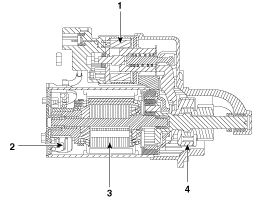
| 1.Solenoid 2.Brush assembly 3.Armature 4.Overrun clutch |
 Starting System
...
 Repair procedures
Starter Circuit Troubleshooting
The battery must be in good condition and fully charged.
1.
Disconnect the fuel pump relay (A) in the fuse box.
2.
With the shif ...
Other Information:
Rear Assist Arm: Repair procedures
Replacement
1.
Remove the rear wheel & tire.
Tightening torque :
88.3 ~ 107.9N.m (9.0 ~ 11.0kgf.m, 65.1 ~ 79.6lb-ft)
Be careful not to damage to the hub bo ...
Tight corner brake effect
Tight corner brake effect is a unique characteristic of four-wheel drive vehicles
caused by the difference in tire rotation at the four wheels and the zero-degree
alignment of the front wheels and ...
Categories
- Home
- Kia Sportage QL (2015-2019) Owners Manual
- Kia Sportage QL (2015-2019) Service Manual
- Kia Sportage SL 2010-2016 Owners Manual
- Kia Sportage SL 2010-2016 Service Manual

Copyright © www.kispmanual.com 2014-2026