
 Kia Sportage: Knock Sensor (KS): Description and Operation
Third generation SL (2010–2016) / Kia Sportage SL Service & Repair Manual / Engine Control / Fuel System / Engine Control System / Knock Sensor (KS): Description and Operation
| Description |
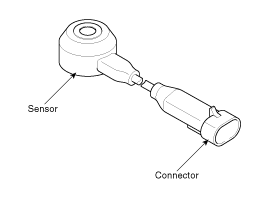
Knocking is a phenomenon characterized by undesirable
vibration and noise and can cause engine damage. Knock Sensor (KS) is
installed on the cylinder block and senses engine knocking.
When knocking occurs, the vibration from the cylinder block
is applied as pressure to the piezoelectric element. When a knock
occurs, the sensor produces voltage signal. The ECM retards the ignition
timing when knocking occurs. If the knocking disappears after retarding
the ignition timing, the ECM will advance the ignition timing. This
sequential control can improve engine power, torque and fuel economy.
 Camshaft Position Sensor (CMPS): Repair procedures
Inspection
1.
Check the signal waveform of the CMPS and CKPS using the GDS.
Specification: Refer to “Wave Form”
Removal
•
DON’T remove the c ...
 Knock Sensor (KS): Specifications
Specification
ItemSpecificationCapacitance (pF)850 ~ 1,150
...
Other Information:
Rear Lower Arm: Repair procedures
Replacement
1.
Remove the rear wheel & tire.
Tightening torque :
88.3 ~ 107.9N.m (9.0 ~ 11.0kgf.m, 65.1 ~ 79.6lb-ft)
Be careful not to damage to the hub bol ...
Blower Unit: Repair procedures
Replacement
1.
Disconnect the negative (-) battery terminal.
2.
Remove the crash pad and heater blower unit.
(Refer to HA group - "Heater Unit")
3.
Remove the heater blower unit (A) fro ...
Categories
- Home
- Kia Sportage QL (2015-2019) Owners Manual
- Kia Sportage QL (2015-2019) Service Manual
- Kia Sportage SL 2010-2016 Owners Manual
- Kia Sportage SL 2010-2016 Service Manual

Copyright © www.kispmanual.com 2014-2026