
 Kia Sportage: Knock Sensor (KS): Description and Operation
Third generation SL (2010–2016) / Kia Sportage SL Service & Repair Manual / Engine Control / Fuel System / Engine Control System / Knock Sensor (KS): Description and Operation
| Description |
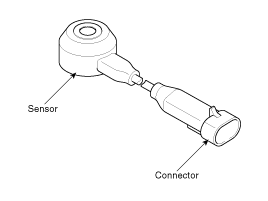
Knocking is a phenomenon characterized by undesirable
vibration and noise and can cause engine damage. Knock Sensor (KS) is
installed on the cylinder block and senses engine knocking.
When knocking occurs, the vibration from the cylinder block
is applied as pressure to the piezoelectric element. When a knock
occurs, the sensor produces voltage signal. The ECM retards the ignition
timing when knocking occurs. If the knocking disappears after retarding
the ignition timing, the ECM will advance the ignition timing. This
sequential control can improve engine power, torque and fuel economy.
 Camshaft Position Sensor (CMPS): Repair procedures
Inspection
1.
Check the signal waveform of the CMPS and CKPS using the GDS.
Specification: Refer to “Wave Form”
Removal
•
DON’T remove the c ...
 Knock Sensor (KS): Specifications
Specification
ItemSpecificationCapacitance (pF)850 ~ 1,150
...
Other Information:
Tire specification and pressure label
The tires supplied on your new vehicle are chosen to provide the best performance
for normal driving.
The tire label located on the driver's side center pillar gives the tire pressures
reco ...
Tight corner brake effect
Tight corner brake effect is a unique characteristic of four-wheel drive vehicles
caused by the difference in tire rotation at the four wheels and the zero-degree
alignment of the front wheels and ...
Categories
- Home
- Kia Sportage QL (2015-2019) Owners Manual
- Kia Sportage QL (2015-2019) Service Manual
- Kia Sportage SL 2010-2016 Owners Manual
- Kia Sportage SL 2010-2016 Service Manual

Copyright © www.kispmanual.com 2014-2026