
 Kia Sportage: Battery
For best battery service
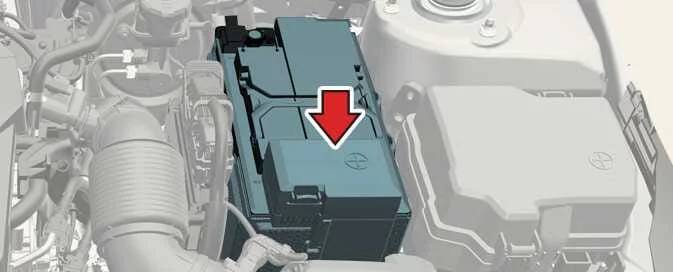 |
-
Make sure the battery is securely mounted.
-
Keep the top of the battery clean and dry.
-
Keep the battery terminals and connections clean and tight. Protect them with petroleum jelly or terminal grease.
-
If electrolyte spills from the battery, rinse it off immediately with a solution of water and baking soda.
-
If the Kia Sportage will remain unused for an extended period, disconnect the battery cables.
Warning
 Read and follow these instructions carefully whenever you
handle the battery.
 Keep lit cigarettes, open flames and sparks away from
the battery.
 Battery cells always contain hydrogen, a highly
combustible gas that may explode if ignited.
 Keep the battery out of children’s reach. It contains highly
corrosive sulfuric acid. Do not allow battery acid to contact your skin, eyes, clothing or the vehicle’s paintwork.
 If electrolyte gets into your eyes, flush them with
clean water for at least 15 minutes and seek immediate medical attention.
If electrolyte contacts your skin, wash the affected area thoroughly. If you feel pain or a burning sensation, seek medical attention immediately.
 Wear eye protection when charging the
battery or working near it. If you are working in an enclosed space, make sure it is properly ventilated.
 Improper battery disposal can harm people and the
environment. Dispose of the battery in accordance with local laws and regulations.
-
When lifting a battery with a plastic case, excessive pressure can cause acid to leak and result in injury. Use a battery carrier, or lift it with your hands positioned at opposite corners.
-
Never attempt to recharge the battery while its cables are connected.
-
The electrical ignition system operates at high voltage. Never touch its components while the engine is running or the ignition is switched on.
Failure to follow these precautions may result in serious injury or death.
Caution
Connecting unauthorised electronic equipment to the battery may discharge it. Use only authorised devices.
Note
The Kia Sportage is equipped with a maintenance-free battery. If your vehicle has a battery marked LOWER
and UPPER on its side, you can check the electrolyte level; it should be between these marks. If the
level is low, add distilled or demineralised water only. Never add sulfuric acid or other electrolyte. Add water
carefully to avoid splashing the battery or nearby components, and do not overfill the cells, as this may cause
corrosion on other parts. Make sure the cell caps are tightened securely after checking.
For battery inspection or service, contact a professional workshop. Kia recommends visiting an authorised Kia dealer or service partner.
Battery capacity label
|
Figure 1. Example 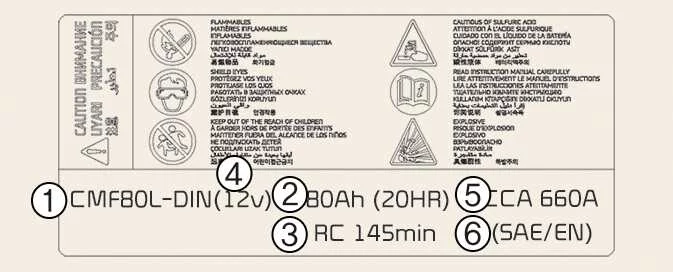
|
The battery label fitted to your vehicle may differ from the example shown. Use the label on the battery itself to identify its specifications.
-
Kia battery model name
-
Nominal capacity, in ampere-hours
-
Nominal reserve capacity, in minutes
-
Nominal voltage
-
Cold-test current in amperes, according to SAE
-
Cold-test current in amperes, according to EN
Battery recharging
If the Kia Sportage battery becomes discharged, run the engine for at least 60 minutes, either while driving or at idle. Alternatively, use a fully automatic, regulated battery charger connected to the front jump-start posts in the engine compartment or directly to the battery in the engine compartment.
Warning
Charging the battery
-
Follow these precautions whenever the battery is being recharged:
-
Remove the battery from the vehicle and place it in a well-ventilated area before charging.
-
Keep cigarettes, sparks and open flames away from the battery.
-
Monitor the battery while it is charging. Stop charging or reduce the charging rate if the cells begin to gas or boil violently, or if the electrolyte temperature in any cell rises above 49°C (120°F).
-
Wear eye protection when inspecting the battery during charging.
-
Disconnect the charger in this order:
-
Switch off the battery charger’s main switch.
-
Remove the negative clamp from the battery’s negative terminal.
-
Remove the positive clamp from the battery’s positive terminal.
-
-
-
Before carrying out maintenance or charging the battery, switch off all accessories and stop the engine.
-
When disconnecting the battery, remove the negative cable first. When reconnecting it, attach the negative cable last.
Caution
Do not open or remove the cap on top of the battery. Internal electrolyte may leak out and cause serious injury.
Caution
AGM battery (if equipped)
-
Absorbent Glass Mat (AGM) batteries are maintenance-free and must be serviced by a professional workshop. Kia recommends visiting an authorised Kia dealer or service partner.
Charge an AGM battery only with a fully automatic charger designed specifically for AGM batteries.
-
When an AGM battery needs replacement, have the work carried out by a professional workshop. Kia recommends visiting an authorised Kia dealer or service partner.
-
Do not open or remove the cap on top of the battery. Internal electrolyte may leak out and cause serious injury.
Reset items
After the battery has been discharged or disconnected, some Kia Sportage settings and features may need to be reset.
-
Auto up/down window
-
Panorama sunroof
-
Trip computer
-
Climate control system
-
Driver position memory system
-
Integrated memory system
-
Infotainment system
-
Audio
-
Clock
 Wiper blades
 12V Parking lithium battery
See also:
Wipers and washers
Wipers. Controlling the wipers automatically: (if equipped)
...
Before starting
Close and lock all doors.
Position the seat so that all controls are easily reached.
Adjust the inside and outside rearview mirrors.
Be sure that all lights work.
Check all gauges.
Check ...
Exhaust Manifold: Repair procedures
Removal and Installation
1.
Remove the engine cover.
2.
Disconnect the battery negative terminal (A).
Tightening torque
4.0 ~ 6.0N.m (0.4 ~ 0.6kgf.m, 3.0 ~ 4.4lb-ft)
3.
Disconnect t ...
Categories
- Home
- Kia Sportage NQ5 (2022-2026) Owner's Manual
- Kia Sportage QL (2015-2019) Owner's Manual
- Kia Sportage QL (2015-2019) Service Manual
- Kia Sportage SL 2010-2016 Owner's Manual
- Kia Sportage SL 2010-2016 Service Manual
