
 Kia Sportage: Engine Coolant Temperature Sensor (ECTS): Description and Operation
Third generation SL (2010–2016) / Kia Sportage SL Service & Repair Manual / Engine Control / Fuel System / Engine Control System / Engine Coolant Temperature Sensor (ECTS): Description and Operation
| Description |
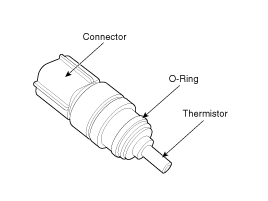
Engine Coolant Temperature Sensor (ECTS) is located in the
engine coolant passage of the cylinder head for detecting the engine
coolant temperature. The ECTS uses a thermistor that changes resistance
with the temperature.
The electrical resistance of the ECTS decreases as the
temperature increases, and increases as the temperature decreases. The
reference +5V is supplied to the ECTS via a resistor in the ECM. That
is, the resistor in the ECM and the thermistor in the ECTS are connected
in series. When the resistance value of the thermistor in the ECTS
changes according to the engine coolant temperature, the output voltage
also changes.
During cold engine operation, the ECM increases the fuel
injection duration and controls the ignition timing using the
information of engine coolant temperature to avoid engine stalling and
improve drivability.
 Intake Air Temperature Sensor (IATS): Repair procedures
Inspection
1.
Turn the ignition switch OFF.
2.
Disconnect the IATS connector.
3.
Measure resistance between the IATS terminals 3 and 4.
4.
Check that the resistance is within the speci ...
 Engine Coolant Temperature Sensor (ECTS): Specifications
Specification
TemperatureResistance (k?)°C°F-40-4048.14-20-414.13 ~ 16.830325.7920682.31 ~ 2.59401041.15601400.59801760.32
...
Other Information:
Battery replacement
A transmitter uses a 3 volt lithium battery which will normally last for several
years. When replacement is necessary, use the following procedure.
1.Insert a slim tool into the slot and gently p ...
Rain Sensor: Repair procedures
Inspection
Rain Sensing Wiper
1.
In IGN2 ON state, if auto switch input (LIN communication) is
ON then both wiper low relay and wiper high relay outputs are
controlled by the rain sensor inpu ...
Categories
- Home
- Kia Sportage QL (2015-2019) Owners Manual
- Kia Sportage QL (2015-2019) Service Manual
- Kia Sportage SL 2010-2016 Owners Manual
- Kia Sportage SL 2010-2016 Service Manual

Copyright © www.kispmanual.com 2014-2026