
 Kia Sportage: Description and Operation
Third generation SL (2010–2016) / Kia Sportage SL Service & Repair Manual / Engine Electrical System / Charging System / Description and Operation
| Description |
The charging system includes a battery, an alternator with a built-in regulator, and the charging indicator light and wire.
The Alternator has built-in diodes, each rectifying AC current to DC current.
Therefore, DC current appears at alternator "B" terminal.
In addition, the charging voltage of this alternator is regulated by the ECM.
The main components of the alternator are the rotor, stator,
rectifier, capacitor brushes, bearings and V-ribbed belt pulley. The
brush holder contains a built-in electronic voltage regulator.
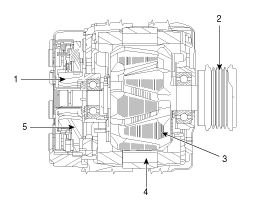
1. Brush
2. Dirve belt pulley
3. Rotor
4. Stator
5. Rectifier
Alternator Management System (AMS)
Alternator management system controls the charging voltage
set point in order to improve fuel economy, manage alternator load under
various operating conditions, keep the battery charged, and protect the
battery from over-charging. ECM controls generating voltage by duty
cycle (charging control, discharging control, normal control) based on
the battery conditions and vehicle operating conditions.
The system conducts discharging control when accelerating a
vehicle. Vehicle reduces an alternator load and consumes an electric
power form a battery.
The system conducts charging control when decelerating a vehicle. Vehicle increases an alternator load and charges a battery.
 Charging System
...
 Repair procedures
On-vehicle Inspection
•
Check that the battery cables are connected to the correct terminals.
•
Disconnect the battery cables when the battery is g ...
Other Information:
Shift lock system
For your safety, the automatic transaxle has a shift lock system which prevents
shifting the transaxle from P (Park) into R (Reverse) unless the brake pedal is
depressed.
To shift the transaxle f ...
TPMS Receiver: Description and Operation
Description
1.
Mode
(1)
Virgin State
•
The receiver as a sole part is shipped in this state. Replacement parts should therefore arrive in this state.
•
In this state, there ...
Categories
- Home
- Kia Sportage QL (2015-2019) Owners Manual
- Kia Sportage QL (2015-2019) Service Manual
- Kia Sportage SL 2010-2016 Owners Manual
- Kia Sportage SL 2010-2016 Service Manual

Copyright © www.kispmanual.com 2014-2026